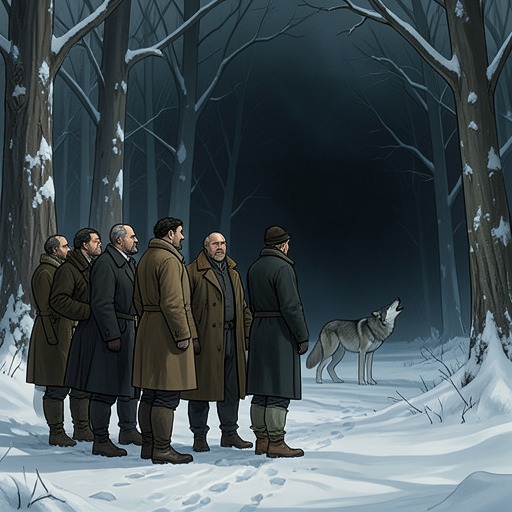
Giants
A Clash of KingsGiants are presented as one of the oldest and most unsettling presences beyond the Wall: not merely monstrous figures in rumor, but a people remembered in ancient records, glimpsed in the wildling host, and identified by the Night’s Watch as part of a wider awakening. Their appearance enlarges the political and imaginative scale of the conflict. The wars of kings continue to occupy the southern kingdoms, yet beyond the Wall an older world is moving again, bringing with it beings that human institutions have nearly forgotten how to understand.
Ancient Records and Lost Knowledge
Samwell Tarly’s discovery in the Night’s Watch library establishes the Giants within a historical tradition rather than treating them as newly invented marvels. Among the maps and scrolls in the vault is an account written by the ranger Redwyn, describing a journey from the Shadow Tower to Lorn Point on the Frozen Shore. The account predates Aegon’s Conquest, since it refers to Dorren Stark as King in the North, and records that the travelers fought Giants. It also says that Redwyn traded with the Children of the Forest, placing Giants within the same older northern world as another people now largely absent from ordinary knowledge.
Sam’s excitement comes from the physical survival of evidence that the present generation has neglected. The manuscript includes maps and descriptions of wildling villages, while other works preserve drawings of the faces in the trees, a book about the language of the Children of the Forest, scrolls from old Valyria, and records of seasons written by maesters dead for a thousand years. In this setting, the Giants are not simply a campfire tale. They are part of a damaged archive whose fragments contradict the narrow assumptions of the living.
Rumor, Propaganda, and the Return of the Old World
The existence of Giants enters the southern war through hearsay. In Harrenhal, Arya Stark overhears archers claiming that Robb Stark has Giants twenty feet tall marching with him from beyond the Wall and following him like dogs. The same speakers call the Starks more wolf than man and use the alleged Giants to enlarge Robb’s reputation as something unnatural and frightening. Their story is not reliable military intelligence; it is hostile gossip, shaped by fear, contempt, and the need to explain the Young Wolf’s victories through a supernatural image.
A similar process turns Grey Wind into a political legend. After the Battle of Oxcross, Rivers recounts that Robb Stark avoided the Tooth by following a goat track supposedly discovered by Grey Wind. The tale grows darker in repetition: some claim that Robb cut out Stafford Lannister’s heart and fed it to the wolf. Catelyn Stark rejects the image of her son as a savage, while Rivers answers that the direwolf is no common wolf and that the old gods of the north may have sent the direwolves to her children. The story of Giants belongs to the same pattern of northern mythmaking, in which military success is narrated as evidence that the Starks are connected to powers outside ordinary human rule.
Giants in the Wildling Host
The clearest sighting comes through Jon Snow’s wolf dream during the ranging beyond the Wall. From an elevated position he surveys a settlement that is not merely an army or a town but an entire people gathered together. Among the tents, animals, smoke, and disorder, a mound across the lake begins to move. It proves to be a shaggy, lumbering beast with a snake-like nose and tusks larger than those of the greatest boar. Its rider is huge as well, with legs and hips too thick to be human. The scene identifies the Giants through scale, bodily difference, and association with the wildling migration rather than through a human narrator’s abstract description.
The vision places Giants within a living social and ecological landscape. They appear among camps, livestock, cookfires, horses, pigs, and dogs, not isolated in a mythical void. At the same time, the scene is saturated with danger: cold raises Ghost’s fur, wings beat above the mountains, and a blue-grey creature plunges from the sky. Giants are therefore one element in a larger concentration of forces that exceed the Night’s Watch’s familiar categories. The northern world contains an organized people, enormous riders, predators, and aerial threats, all encountered from the perspective of a consciousness moving between human and wolf forms.
The Warning to the Night’s Watch
Qhorin Halfhand treats the Giants as evidence that the threat beyond the Wall is broader than ordinary wildling warfare. After a shadowcat attack leaves Stonesnake’s mare with a broken leg, Qhorin refuses to let the ranger remain behind to ambush the pursuing enemy. Instead, he sends Stonesnake alone and on foot toward the Fist, instructing him to tell Jeor Mormont what Jon saw. The message is explicit: old powers are waking, and the Night’s Watch must be warned of Giants, wargs, and worse, as well as of trees that have eyes again.
This warning changes the function of Giants in the narrative. They are not only wonders preserved in Sam’s books or frightening details in a hostile rumor. They become part of an operational assessment by experienced rangers. Qhorin places them alongside skinchangers and other signs of supernatural resurgence, making their return a strategic fact even before the Watch can fully explain what it means. The danger is intensified by the terrain itself: the Frostfangs are cold, lonely, and difficult to cross, and Stonesnake’s departure leaves Jon and Qhorin more isolated as they continue through the mountains.
Narrative Significance
Giants unsettle the boundary between history and superstition. The old manuscript proves that they belonged to the remembered past, the wildling host gives them a present body, and the Night’s Watch’s warning gives them a future consequence. Their recurrence also exposes how knowledge is controlled by distance and neglect. In the south, Giants can be exaggerated into a boast or insult; in the library, they survive as a half-legible record; beyond the Wall, they are part of a world that has never ceased to exist.
Their importance lies partly in their refusal to remain a simple metaphor. They carry political meaning when enemies invoke them to make Robb Stark seem monstrous, but the narrative also grants them physical presence, movement, habitat, and participation in a people’s migration. The result is a challenge to human-centered power: kings may crown themselves, fleets may assemble, and armies may divide the realm, yet the most consequential transformation may be taking place beyond the structures built to record human history. The Giants’ return signals that the old world is not dead; it has been waiting outside the boundaries of ordinary sight.